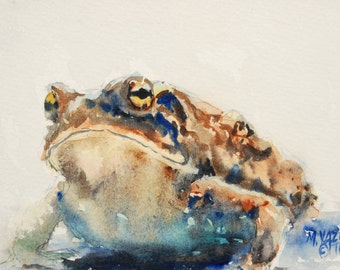
In the medieval era, a common "remedy" for painful menstrual cramps was burning a toad, placing the ashes in a pouch, and wearing the pouch around the waist until the cycle ended.
The fish tank in the OB-GYN waiting room is gone, replaced with a state-of-the-art toad tank. Every few minutes a nurse with thick purple gloves walks in, reaches into the tank, pulls out a prime toad specimen--robust, lumpy--and shuffles away with the creature in hand. Think Red Lobster but with more croak. The entire office smells like fried frog legs. The aroma is somehow comforting, therapeutic, the way a dentist office smells somewhat of chlorine.
The demand for toad-ash treatment soon outgrows the facilities of hospitals and private practices, so the ashes join Advil and NyQuil as an over-the-counter remedy. The ashes are sold in convenient little packets, like heroin, though much cheaper than heroin because there are only two ingredients: toad and fire.
With the low cost and high demand for these croaking creatures, toads quickly become an endangered species, altering the ecosystems of their natural habitats. Cue toad-rights activists. Save-the-toad rallies in DC. New brands of synthetic toad ashes and ashes of toads that died of "natural causes" have short-lived success on Walmart shelves, soon replaced by the experimental frog-ashes. This amphibian alternative is of course a sham and does nothing to help women's menstrual cramps. A long and unnecessary lawsuit follows.
Then there’s the pouches. First, women try to be discreet. Consider the pouches to be an external menstrual pad, a sign of womanhood and, in this case, severe pain. Pop culture treats the pouches like it treats tampons or terrorist groups, or like how it used to treat the topic of sex. But feminists help remove the stigma on toad-ash pouches. Pouches become a bedazzled statement piece, as necessary as hipster glasses or a topaz nose ring. Before the sensation becomes cliché, Vera Bradley produces a chic line of durable and stylish toad-ash pouches with a variety of patterns, colors, and sizes (for women in need of a particularly large dose). Knock-off pouches are available at Target, along with scented ashes.
Overtime, girls and women with painful periods become empowered by their toad-ash pouches. A Miss America contestant gains both praise and criticism for wearing her toad ash pouch during the swimsuit competition. “I want to be a role model for young girls and women who also have to wear a toad-ash pouch,” she says during an interview on LIVE! With Kelly and Michael. “I want to show that I’m just a normal, everyday girl, who happens to wear a toad-ash pouch, and that’s okay.”
Aristotle explained that the difference between the sexes was the ability or inability to produce semen. Women were “deformed” versions of men, weaker mentally and physically, and menstrual blood was a sickly, “passive” form of semen that needed “active” semen from a man to create life. A woman’s purpose began and ended with her ability to menstruate, carry, then deliver the life created solely by man.

Chaz Bono is famous. By which I mean he has famous parents, Cher and Sonny Bono, that nudged him in the general direction of stardom—reality tv as a toddler, a low key music career out of high school, then (quite publicly), a substance abuse problem followed by a hysterectomy and a two year female to male gender transition process, which is followed in detail with “Becoming Chaz,” the documentary that brought Chaz an Emmy nomination and perhaps a more authentic form of fame. He’s an LGBT activist, a transgender role model, and has the best quotes about shaving that will ever be featured on brainyquote. Not to mention a Dancing with the Stars hall of famer.
Quite the résumé. As I said: Chaz Bono is famous. He is much more interesting than you or me or Aristotle. And one of those reasons (though much lesser known) is that Chaz Bono has endometriosis.
Endo’s not a rare disease, but it’s also not popular. People don’t talk about it, probably because the main symptom is severe menstrual cramping, and it also isn’t something we associate Chaz Bono with because, well, he’s a guy. But it was endometriosis pain that led to his addiction to pain meds (same fate as many endometriosis patients), his substance abuse, and eventual hysterectomy. It’s his endometriosis that has allowed him to be an inspiration for not only the LGBT community, but for people like me that also have endo.
When I discovered Chaz Bono had endometriosis, I had been on a search for strong women. I was recently diagnosed—young, scared, hardly able to pronounce this disease that was going to bring debilitating pain like clockwork for the rest of my menstruating life. I googled "famous people with endometriosis" and found just what I thought I needed; Marilyn Monroe, Dolly Parton, Whoopi Goldberg, Jillian Michaels, Susan Sarandon, all glorious, glamorous creatures, diseased just like me but more defiant, more fabulous in their endometriosisness.
But then there was Chaz. Chaz, with his unique situation. Chaz, who had felt the same pain I’ve felt, maybe worse, definitely more heartbreaking because his body and his brain were pulling in a stalemate tug of war, Chaz in the middle, and the midst of it all he had endometriosis to deal with. About being transgender, Chaz once stated, “There's a gender in your brain and a gender in your body. For 99 percent of people, those things are in alignment. For transgender people, they're mismatched. That’s all it is. It’s not complicated.”
Not complicated, but revolutionary just the same, especially to individuals crutched on Aristotle's philosophy of the genders: women are weak, men are strong, and the evidence is in menstruation. But Chaz Bono argues (seems to prove, in fact) that being a woman or being a man is about more than just semen vs menstrual blood, about having periods or not having periods. Our bodies are only a fraction of our identities, with the majority of who we are--of what it means to be a man or a woman--found beyond the tangible. As Chaz said, in the brain. Allow me stretch this and suggest in the soul. This means Chaz and I aren't labeled or limited by our endometriosis, that being a human means more than being biologically male or female, and that a woman's purpose goes far past her ability to menstruate.